· 5 min read
The snags we hear about after a 240SX 5-lug hub swap
A front hub that won't go on the spindle, play that goes away at torque, which nut spec to use, and noise after the swap: what to check first.
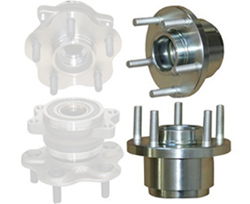
If a new front hub won’t go on the spindle, you almost certainly have the S13 front on S14 knuckles, or the other way around. If a hub has play on the bench, torque it on the car before you decide it’s bad.
Below is roughly the order we go through it over email, front hubs first because that’s where most of it happens.
The front hub stops halfway onto the spindle
The factory’s drawings for our hubs give the S13 front a 30 mm bearing bore and the S14 front a 34 mm one. Put an S13 front on an S14 spindle and it stops partway, because the bore is too small. An S14 front on an S13 spindle is the wrong part too, and the S13’s nut and cotter pin won’t go on as they should. The rear is one part for both cars, so this only happens up front, and we’ve had buyers put the rears in over a weekend with no trouble and then hit the wall on the fronts.
A lot of people have read that S13 and S14 hubs are the same. On the front they aren’t.
Before you blame the part, look at the bare spindle. The S13’s factory front bearing is a double-row unit with a split inner ring, and owners on zilvia have pulled the old hub and left half of that inner race stuck on the spindle. The new hub won’t seat over it, and from the outside it looks a lot like the wrong-part problem.
So what’s on the car? Most often the wrong front pair simply got ordered. Sometimes it’s an S13 whose knuckles somebody changed years ago, and the current owner never knew. Measure the spindle where the bearing sits with a vernier or digital caliper; the two sizes are 4 mm apart. If it’s 30 mm you want the S13 front pair, and if it’s 34 mm you want the S14 front pair. The S13 and S14 pages go through the rest of the differences.
We don’t always get this one right on our end. This year a buyer asked us more than once how big the hole through the bearing was, because their spindle was 34 mm and the hub wouldn’t go on, and we kept answering with the stud sizes. What they needed was: the hub in your hand is the 30 mm S13 front, and a 34 mm spindle takes the S14 front.
It isn’t always the buyer, either. We’ve had people tell us one front slid straight on and the other wouldn’t go all the way, same car, same afternoon. We’ve had others convinced one hub in an S13 pair was an S14 because it sat differently from its partner. So a mixed pair in the box is the first thing we rule out on our side, and a photo of the box and the packing slip tells us what was picked for that order faster than trading measurements.
Test-fit each front by hand on the bare spindle before anything gets greased or bolted. If it stops, put it back in its wrappers. A clean, unused hub can come back within 30 days. An installed one, or one that comes back oily, can’t. We’ve had one come back with grease on it from a buyer who said it was only out of the box for thirty seconds, and it still couldn’t go back on the shelf as new.
Is a hub with play out of the box bad?
Not necessarily. One buyer wrote to us that a rear moved back and forth as it came out of the box, and we asked for a picture. Before they sent one they wrote back: once the rear nut was on and tightened, the play was gone.
If it still moves once it’s on the car and torqued, it’s bad. Play and noise are what people report to us most, fronts and rears both, so you’re not the first. Send a short video of that hub on the car with the nut torqued, plus your order number and which corner it is. A bad hub comes back to us, we pay the return shipping and we send a replacement. Most replacements ship within a week.
The opposite worry comes up too: a buyer asks whether the hubs are checked so they don’t bind once they’re torqued, because a set from somewhere else did. The factory that makes our hubs checks every one before it’s packed. If one of ours feels tight after you torque it, the video and the order number are still what we need.
A whine showed up after the swap
Before you blame a bearing, look at the dust shield, the thin plate behind the hub that the service manual calls a baffle plate. Owners who chased a whine after this swap on zilvia found the shield touching the rotor, or a hub nut that wasn’t torqued right. Both are free to fix.
Then check which hubs actually got changed. This year we told a buyer with a noise on one side that it was probably the old hub, because our lookup showed one front on the order. They’d bought two and had to tell us. So before you pull a hub back off for noise, confirm which corners are actually new, especially on a car you bought half-swapped.
Which torque spec, and whose?
We don’t publish torque figures of our own. These are from the Nissan factory service manuals (front axle and rear axle sections, 1994 for the S13 and 1997 for the S14):
| Fastener | Factory service manual |
|---|---|
| S13 front wheel bearing lock nut | 147-216 N·m (108-159 ft-lb), then a cotter pin |
| S14 front wheel bearing lock nut | 206-284 N·m (152-210 ft-lb), clinched in two places |
| Rear wheel bearing lock nut | 206-275 N·m (152-203 ft-lb) |
| Rear wheel bearing housing bolts, four | 78-98 N·m (58-72 ft-lb) |
| Wheel nuts, S13 and S14 | 98-118 N·m (72-87 ft-lb) |
The question we get is whether an S13 running these hubs takes the S13 or the S14 number. Go by the knuckle. S13 knuckles with our S13 fronts get the S13 figure and the cotter pin. If your S13 has S14 knuckles on it, you’re running S14 fronts, and they get the S14 figure and the clinched nut.
The box holds the hub with its bearing pressed in and the studs installed. There’s no nut, cotter pin or bolt in it, front or rear, so have yours ready before the car goes up. An S13 front needs a fresh cotter pin, and the rear nut takes one too.
The rear pair fits both cars and comes as a hub already pressed into its bearing housing, so you swap the whole unit. With the brake off that corner, pull the cotter pin and adjusting cap, take off the lock nut (owners on zilvia use a 36 mm socket on it), then the four housing bolts from the inboard side. The new unit slides over the axle splines and goes on with the same four bolts. The nut goes back on to the figure in the table, then the adjusting cap and a fresh cotter pin.
Stuck on any of it, email us the order number, which corner, and a video with the nut torqued.
Questions
- My new front hub won't slide onto the spindle. Is it defective?
- Usually not. The S13 front hub has a 30 mm bearing bore and the S14 front has 34 mm, so a hub for the other chassis either stops partway or sits loose. Measure the spindle and compare it to what's in the box before anything else.
- Does the hub come with a new nut or cotter pin?
- No. Each box holds the hub with its bearing pressed in and the studs installed. There's no nut, cotter pin or bolt in any box, front or rear, so have those ready before the car is in the air.
- What torque goes on the hub nut?
- We don't publish a figure of our own. The factory service manual gives 147-216 N·m (108-159 ft-lb) for the S13 front lock nut, 206-284 N·m (152-210 ft-lb) for the S14 front and 206-275 N·m (152-203 ft-lb) for the rear. Go by the knuckle the hub is on, not the badge on the car.
- One hub has play out of the box. Should I send it back?
- Put it on the car and torque the nut first. If it still has play, send us a short video of that hub on the car with your order number. A bad hub comes back to us at our cost and we send a replacement.
Not sure which kit fits your car?
Search by year, make and model and we’ll take you to the kit that fits.